
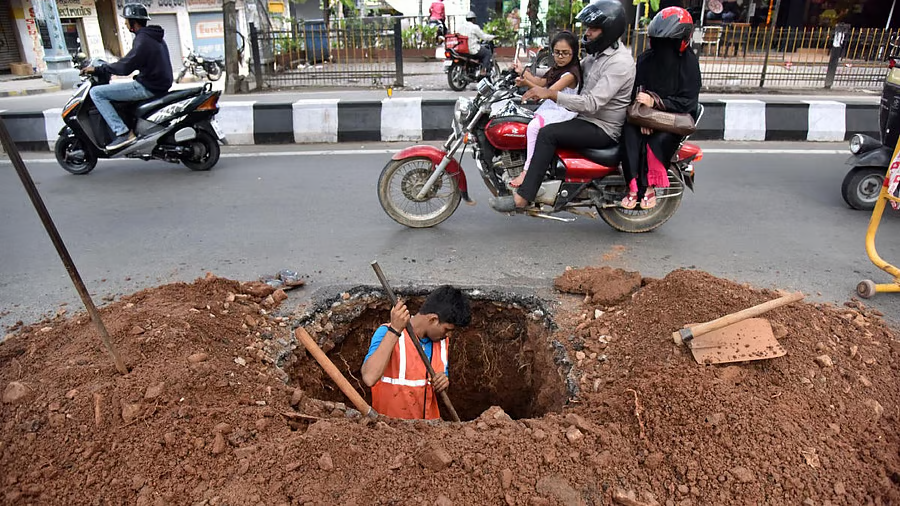
Bengaluru: The Bangalore Water Supply and Sewerage Board (BWSSB) has deployed robotic technology to detect leakages and inspect underground pipelines at nearly 399 locations across Bengaluru over the past six months, significantly reducing the need for road excavation and traffic disruption.
The initiative, officially launched in November 2025, was introduced to identify water pipeline leaks and sewerage faults without digging up roads in the city. Officials said the technology has helped improve efficiency while minimising inconvenience to motorists and residents.
According to BWSSB, robotic units have already surveyed more than 32 kilometres of underground infrastructure and detected critical faults without requiring large-scale excavation work.
Robotic technology transforming pipeline inspections
BWSSB officials said the newly introduced robotic systems are capable of travelling through underground pipelines and accurately locating faults, leakages and blockages from within the network itself.
Traditionally, civic agencies were required to dig up stretches of roads to identify leakage points or damaged sewerage lines, often leading to prolonged traffic congestion and public inconvenience in Bengaluru’s busy urban areas.
However, the use of robotic inspection systems has enabled authorities to avoid unnecessary road cutting while speeding up repair and maintenance activities.
Officials explained that the robotic units are equipped with cameras and inspection tools that help engineers monitor underground conditions in real time and identify exact fault locations with precision.
The technology is also expected to reduce maintenance costs and prevent delays associated with manual inspection methods.
Hundreds of complaints resolved
According to BWSSB data, the board received 404 complaints related to pipeline leakages and sewerage faults during the last six months.
Out of these, 399 complaints were resolved using robotic inspection technology, while the remaining five cases are currently being addressed on priority.
Authorities said the initiative has helped improve response time and reduce the disruption usually caused by conventional excavation-based repairs.
Officials noted that the robotic inspections proved especially useful in densely populated areas and major traffic corridors where road digging often creates severe congestion.
BWSSB chairman highlights public benefits
Ramprasat Manohar V, Chairman of BWSSB, said the adoption of robotic technology has brought a major change in the way underground infrastructure faults are handled in Bengaluru.
He stated that road cutting was previously unavoidable while locating leaks and sewerage issues, leading to major inconvenience for the public and commuters.
According to the chairman, the initiative was implemented following directions from Deputy Chief Minister D. K. Shivakumar to reduce public hardship caused by frequent road excavations.
He said the robotic machines travel through underground pipelines and precisely identify defects without disturbing the road surface, thereby helping authorities avoid unnecessary traffic disruptions.
Officials added that the system has proven effective in handling complaints quickly while improving overall maintenance efficiency within the city’s water and sewerage network.
Push towards smart urban infrastructure
The robotic inspection initiative forms part of BWSSB’s broader efforts to modernise Bengaluru’s ageing water supply and sewerage infrastructure through technology-driven solutions.
The board is also preparing to launch what it describes as Asia’s largest water and sewerage monitoring command centre to strengthen real-time monitoring and management of urban utility systems.
Urban infrastructure experts believe such technologies could play an important role in reducing civic disruptions in rapidly growing metropolitan cities like Bengaluru, where road excavation works frequently lead to traffic bottlenecks and public complaints.
Residents have often criticised repeated road digging by various civic agencies, particularly during monsoon periods when damaged roads and unfinished repairs worsen traffic conditions.
Technology expected to expand further
BWSSB officials indicated that the use of robotic technology is likely to be expanded further in the coming months based on the success of the pilot implementation.
Authorities believe the initiative could become a long-term solution for efficient underground infrastructure management while supporting Bengaluru’s transition towards smarter urban governance systems.
The civic body also expressed confidence that the technology would help improve maintenance standards and reduce inconvenience to citizens in one of India’s fastest-growing metropolitan cities.
Source: