
Insights From Solinas
By Devi, Team Solinas
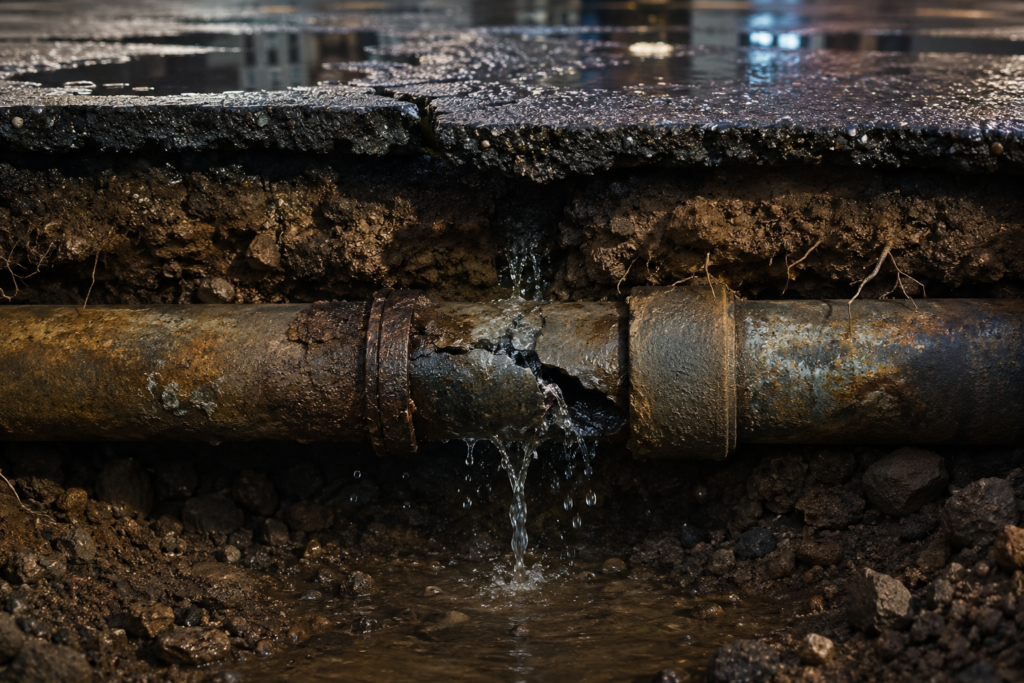
Water Pipeline Failures. It rarely begins with a warning.
A busy street in Chennai slows to a halt. Water starts pooling where vehicles were moving just minutes ago. Shop shutters come down halfway. Residents gather, trying to understand what just happened.
Within hours, complaints rise. Tankers are arranged. Repair teams rush in.
What appears sudden is anything but.
The failure had been building for months, sometimes years. The signs were there. They just weren’t seen or acted on in time.
Why Do Water Pipeline Failures Happen?
Strip away the urgency of a burst pipe, and a pattern emerges. Most failures aren’t random. They are the result of slow, predictable processes that go unnoticed until it’s too late.
1. Corrosion Inside and Outside the Pipe
Inside the pipeline, water chemistry slowly eats away at the material. Factors like pH imbalance, dissolved oxygen, and contaminants weaken the pipe from within.
Outside, soil conditions and moisture accelerate the damage.
By the time a leak becomes visible, the pipe has already lost much of its structural strength.
2. Aging Water Infrastructure
Many urban water networks are operating well beyond their intended lifespan.
Over time:
- Materials degrade
- Joints loosen
- Failure risks increase
In cities like Mumbai, some pipelines are decades or even a century old. They were never designed for today’s demand or pressure levels.
This is where a more proactive, Condition Based assessment becomes essential one that focuses on understanding how pipelines are performing today, not just when they were installed.
3.Unauthorized Connections and Illegal Tapping
In many urban and peri-urban areas, pipelines are altered without proper oversight.
- Illegal connections are added
- Improper tapping weakens pipe walls
- Pressure balance is disturbed
These changes introduce new leak points and contamination risks. Worse, they are rarely documented making them difficult to detect through traditional methods.
4. Poor Installation and Material Quality
Some failures are built into the system from the start.
- Improper jointing
- Misalignment during installation
- Substandard materials
These issues may not show up during routine operations. But when the system is stressed, they become points of failure.
5. Lack of Visibility Into Pipeline Health
This is where most utilities struggle.
Without visibility, every other effort becomes reactive.
Teams often operate with:
- Limited understanding of internal pipe condition
- No clear mapping of weak zones
- Delayed responses to developing issues
At this point, it’s no longer a technology problem. The tools exist. The gap lies in adoption.
Real Impact of Water Pipeline Failures
The consequences go far beyond a single burst.
- Non-Revenue Water (NRW): A significant portion of treated water is lost before reaching consumers
- Operational costs: Emergency repairs cost far more than planned maintenance
- Public health risks: Contaminants can enter through damaged sections
- Service disruptions: Affecting homes, industries, and essential services
How Solinas Helps Prevent Water Pipeline Failures?
At Solinas, we believe pipeline failures are rarely random, and water leak detection systems are need of the hour. Most of them leave warning signs long before a breakdown happens.
That is why prevention starts with visibility.
1. Inspect Before Failure Happens
Most utilities still rely on external symptoms like pressure drops, customer complaints, or visible leaks.
By then, the issue had already escalated.
With Endobot, we enable in-pipe robotic inspection for live water pipelines, allowing utilities to assess pipeline health from the inside without excavation or service disruption.
This helps identify:
- Internal corrosion
- Cracks and structural deformities
- Leak points and weak joints
- Sedimentation or blockage build-up
- Ferrules
- Illegal connections
Instead of waiting for a pipe burst, utilities can detect vulnerabilities early and intervene with precision.
Explore how Endobot enables non-invasive pipeline inspection.
2. Move From Manual Assessment to AI-Based Decision Making
Inspection alone is not enough. The real value lies in converting raw inspection footage into actionable insights.
This is where Swasth AI comes in.
Swasth AI analyses inspection data to detect anomalies, classify defects, and generate condition intelligence faster than manual review.
Utilities can use this data to:
- Prioritise high-risk assets
- Plan targeted maintenance
- Reduce unnecessary replacements
- Improve budget allocation
- Pipeline life and RUL
3. Reduce Non-Revenue Water Through Early Leak Detection
Many remain hidden for months, contributing to Non-Revenue Water losses and gradual asset deterioration. By combining robotic inspection with AI-powered analysis, Solinas helps utilities identify hidden leaks before they become major failures.
This supports:
- NRW reduction initiatives
- Better supply reliability
- Lower operational losses
This approach has already been deployed in projects focused on urban water management and network optimisation.
4. Enable Predictive Maintenance, Not Emergency Repairs
Traditional maintenance is often reactive.
A failure happens. Teams respond.
But reactive operations are expensive, disruptive, and inefficient.
Solinas helps utilities shift toward predictive asset management by providing continuous infrastructure intelligence.
This allows teams to answer critical questions:
- Which pipelines are most likely to fail?
- Which assets need immediate attention?
- Where should budgets be allocated first?
The result is fewer emergency repairs and more planned interventions.
5. Save Significant Time & Inspection Costs
Compared to traditional inspection methods, robotic pipeline inspection delivers substantial savings in both time and operational cost.
Cost Savings
Traditional inspection and fault identification methods often involve excavation, manual assessment, traffic disruption, and extended workforce deployment.
With robotic inspection, utilities can save approximately ₹6–8 lakhs per kilometre by reducing excavation requirements, minimising operational disruption, and enabling targeted repairs instead of large-scale replacements.
Faster Detection
Conventional methods can take 1–2 weeks to locate and assess pipeline issues accurately.
Using robotic inspection systems like Endobot, critical defects can often be identified within 2–3 hours, enabling faster decision-making and quicker intervention.
This means:
- Reduced downtime
- Faster maintenance planning
- Minimal disruption to water supply
- More efficient field operations
Conclusion
Water pipeline failures are not sudden. They are built over time.
The difference between disruption and control comes down to one thing – Visibility.
At Solinas Integrity, the focus is simple. Help utilities see early, act early, and prevent failures before they surface.