
Insights From Solinas
By Amreen, Team Solinas
Underground pipeline infrastructure forms the backbone of water and sanitation systems. Yet over time, leaks, corrosion, pressure variations, temperature changes, and external stressors silently degrade pipeline integrity. These hidden failures lead to rising operational costs, infrastructure damage, and significant losses through Non-Revenue Water (NRW).
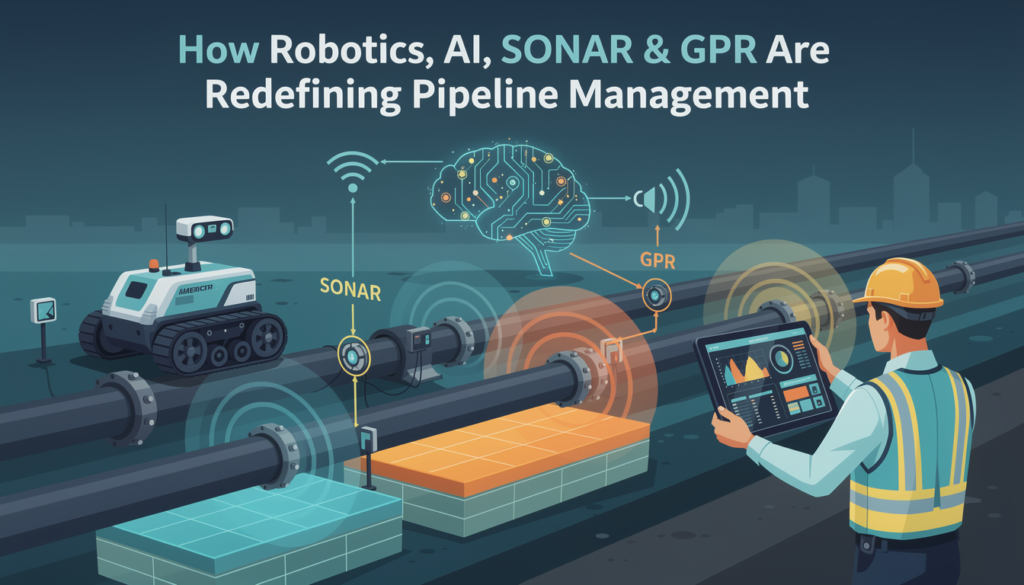
As a leader in Robotics and AI-driven solutions for WASH infrastructure, Solinas Integrity is transforming how utilities are inspected, detected and resolved. Through our robot series like the Endobot Series and HomoSep, we bring intelligent automation into sewer and sanitation operations enabling safe, efficient, and data-driven interventions. In addition to our robots, we also offer advanced non-invasive inspection services powered by SONAR, Ground Penetrating Radar (GPR), and Acoustic technologies to deliver comprehensive underground pipeline diagnostics.
Traditionally, locating pipeline defects required extensive trenching along suspected stretches of pipeline. This approach is time-consuming, expensive, and disruptive to traffic, businesses, and communities. Identifying the exact failure point can take days, increasing both economic and environmental costs.
As urban networks expand and infrastructure ages, conventional inspection methods are no longer sufficient.
Today, advanced non-invasive inspection technologies such as SONAR, Ground Penetrating Radar (GPR), and Acoustic Leak Detection are redefining underground pipeline monitoring. At Solinas Integrity, we leverage these advanced sensing technologies alongside our AI-powered robotic platforms to enable precise underground pipeline inspection, reduce water loss, minimize disruption, and support data-driven infrastructure management across the WASH ecosystem.
SONAR Pipeline Inspection: Seeing Inside Water-Filled Pipelines
SONAR (Sound Navigation and Ranging) technology uses high-frequency sound pulses to inspect pipelines internally. These sound waves travel through water and reflect off pipe walls, sediment buildup, debris, and structural defects.
By measuring:
- Echo return time
- Signal strength
- Sound wave patterns
SONAR systems generate detailed cross-sectional images of pipeline interiors. This enables accurate pipeline condition assessment without excavation or service interruption.
Where SONAR is Most Effective
SONAR pipeline inspection is particularly valuable for:
- Sewer mains
- Wastewater pipelines
- Force mains
- Large-diameter pipelines
- Submerged or water-filled infrastructure
Unlike CCTV inspection, which can be limited in submerged conditions, SONAR performs reliably in fully or partially filled pipelines.
Key Applications
Sewer & Wastewater Inspection
Detects sediment buildup, blockages, and structural deformation in submerged systems.
Sediment & Debris Mapping
Identifies capacity-reducing accumulation, enabling targeted cleaning and maintenance.
Structural Integrity Assessment
Detects corrosion, cracks, joint displacement, and pipe deformation.
Large-Diameter Pipeline Inspection
Efficiently inspects critical trunk mains without costly excavation.
Benefits of SONAR Pipeline Inspection
- Non-invasive pipeline inspection
- No service interruption
- Accurate internal imaging
- Reduced emergency repairs
- Improved asset lifecycle management
By integrating SONAR data into digital asset management systems, utilities can shift toward predictive maintenance and smarter underground infrastructure management.
Ground Penetrating Radar (GPR): Mapping Buried Pipelines Without Excavation
Ground Penetrating Radar (GPR) surveys provide high-resolution subsurface imaging for underground pipeline infrastructure. Using electromagnetic radar pulses, GPR detects buried pipelines, voids, and soil disturbances without disturbing the ground.
How GPR Works
A transmitting antenna sends radar waves into the ground. When these waves encounter buried utilities or material changes, they reflect back to a receiving antenna. The reflected signals are processed to create detailed subsurface images.
- High-frequency radar: Higher resolution for shallow pipelines
- Low-frequency radar: Greater depth penetration for deeply buried pipelines
How GPR Supports Pipeline Infrastructure
Underground Pipeline Mapping
Creates accurate digital maps of water, sewage, gas, and industrial pipelines.
Leak Detection & Risk Assessment
Identifies soil anomalies and voids that may indicate leaks or pipeline misalignment.
Pipeline Condition Assessment
Detects structural shifts, cracks, and subsurface void formation.
Benefits of GPR for Underground Pipelines
- Non-destructive subsurface imaging
- Reduced excavation risk
- Cost-effective project planning
- Improved construction safety
- Faster infrastructure assessment
GPR plays a critical role in preventing accidental pipeline strikes and supporting safer urban development.
Acoustic Leak Detection: Listening for Hidden Failures
Acoustic leak detection is one of the most effective technologies for identifying leaks in buried pressurized pipelines. When water escapes from a pipe, it generates a distinct sound signature as vibrations travel through the pipe wall and surrounding soil.
Specialized equipment detects and analyzes these sound patterns to pinpoint leaks accurately.
How Acoustic Leak Detection Works
Listening Devices
Ground microphones and acoustic sensors capture vibrations and sound frequencies.
Sound Analysis
Advanced signal processing distinguishes leak frequencies from background noise.
Pinpointing the Leak
By moving sensors along the pipeline and analyzing sound intensity and frequency, technicians can accurately locate leaks.
Advantages of Acoustic Leak Detection
- Non-invasive leak detection
- No excavation required
- Cost-effective across pipe materials
- Rapid detection and repair
- Reduced Non-Revenue Water (NRW)
Limitations
- Environmental noise interference
- Reduced effectiveness in plastic pipes
- Accuracy influenced by pipe depth and soil conditions
Despite these challenges, acoustic leak detection remains a foundational tool in underground pipeline inspection and continues to evolve with improved sensor and analytics technology.
Building Resilient Water Infrastructure with Advanced Inspection Technologies
As cities face aging water networks, population growth, and climate-related stress, utilities must move from reactive repairs to predictive infrastructure management.
Technologies such as SONAR pipeline inspection, GPR surveys, and acoustic leak detection enable:
- Proactive maintenance
- Reduced water loss
- Lower operational costs
- Improved asset lifespan
- Safer and smarter urban development
At Solinas Integrity, we combine these advanced sensing technologies with data-driven insights to strengthen water and sanitation infrastructure, improve efficiency, and support resilient underground pipeline systems.
The future of pipeline management is not about digging more—it’s about detecting smarter.