
Robotic Sewer Pipeline Inspection for Smarter Network Maintenance
Detect structural defects, blockages, infiltration, illegal connections and sewer deterioration using robotic CCTV inspection and AI-powered condition assessment. Identify hidden problems early, map their exact locations and prioritise maintenance with minimal excavation
1000+ Km
Underground pipeline network digitally mapped
30+ cities
Water infrastructure projects delivered across India
5X
Lower inspection costs with minimal excavation
India’s Leading Sewer Pipeline Inspection Expert
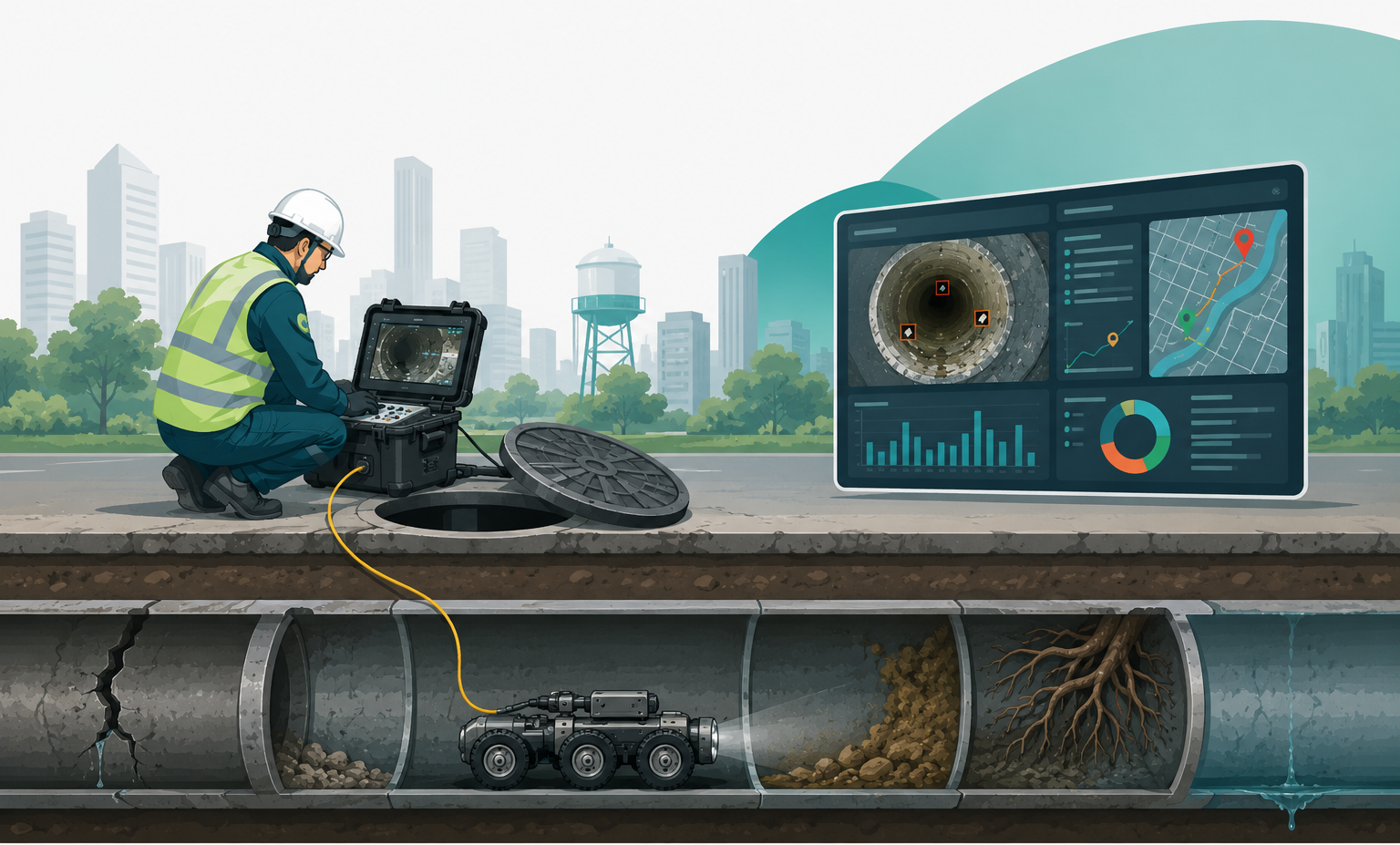
Solinas uses in-house robotic inspection systems to assess sewer pipelines from the inside, helping utilities find problems that are difficult to locate from the surface. CCTV footage reveals cracks, broken or offset joints, root intrusion, grease buildup, sediment and other obstructions that can restrict flow or contribute to overflows.
AI-assisted defect classification and GIS-linked reporting help teams document where issues occur and prioritise cleaning, repair or rehabilitation. For sewer sections with high water levels or limited visibility, sonar-based assessment may provide additional information about the submerged internal profile. The result is a clearer view of sewer condition and a more focused plan for network maintenance, with minimal excavation.
Sewer Networks Fail
Pipe ageing, ground movement and everyday operational stress compound quietly underground until they surface as a blockage, collapse or overflow. If left undetected, these issues can worsen infiltration, exfiltration, structural damage and maintenance costs across the sewer network.
Pipe ageing & ground movement
Root intrusion & joint failure
Grease buildup & fatberg formation
Illegal connections & cross-connections.
Inflow, infiltration & exfiltration
Sediment, corrosion & collapsed sections
Issues We Detect
Our robotic sewer inspection identifies structural, operational and hydraulic issues before they develop into blockages, overflows or major network failures. Detailed defect mapping helps utilities understand the condition of each sewer segment and prioritise timely maintenance.
Cracks & fractures
Pipe crack detection flags early structural weakening.
Pipe collapse
Collapse detection ahead of a road or ground failure.
Broken & open joints
Joint separation that admits soil, roots or contamination.
Deformation & ovality
Pipe deformation signalling bedding or loading failure.
Offset joints
Misaligned sections restricting flow and risking leakage.
Corrosion & scaling
Surface deterioration reducing remaining structural life.
Grease & fatberg buildup
Fatberg inspection flags flow-choking grease masses early.
Sediment & debris
Accumulation that reduces hydraulic capacity over time.
Root intrusion
Root intrusion detection before flow is fully obstructed.
Cross & illegal connections
Illegal sewer connection detection for unauthorised tie-ins.
Obstructions & intrusions
Foreign objects or service intrusions blocking the bore.
Standing water
Indicates sag, blockage or inadequate gradient.
Reduced flow capacity
Cross-section loss from deposits or deformation.
Partial blockage
Sewer blockage detection before it becomes a full backup.
Backflow indicators
Signs of surcharge or reverse flow under wet weather.
Poor gradients
Flat or reverse-graded sections that trap flow and solids.
Cracks & fractures
Pipe crack detection flags early structural weakening.
Pipe collapse
Collapse detection ahead of a road or ground failure.
Broken & open joints
Joint separation that admits soil, roots or contamination.
Deformation & ovality
Pipe deformation signalling bedding or loading failure.
Offset joints
Misaligned sections restricting flow and risking leakage.
Corrosion & scaling
Surface deterioration reducing remaining structural life.
Active leaks
Leak-pinpointing flags flow-loss points before they surface.
Contamination ingress
Contamination checks flag intrusion points along the bore.
Sediment & scaling buildup
Deposits that reduce hydraulic capacity and water quality.
Illegal connections
Illegal connection detection for unauthorised tie-ins.
Obstructions & intrusions
Foreign objects or service intrusions blocking the bore.
Pressure loss zones
Indicates a leak, blockage or undersized section.
Reduced flow capacity
Cross-section loss from scaling, sediment or deformation.
Partial blockage
Blockage detection before it disrupts supply pressure.
Air-lock indicators
Signs of trapped air reducing effective flow.
Poor gradients
Flat or reverse-graded sections that affect flow distribution.
Technologies Used for Industrial Pipeline Inspection
EndoBot Variants
Robotic CCTV inspection across different pipeline diameters and access conditions, capturing direct internal footage of visible defects, obstructions and pipeline condition.
Sonar
Supports inspection where sections are submerged or visual visibility is limited, helping assess internal geometry and conditions below the waterline.
Ground Penetrating Radar
Helps locate buried pipelines and understand surrounding underground context from the surface, supporting inspection planning before physical intervention.
Acoustics
Uses sound and vibration-based signals to investigate possible leakage points where visual inspection alone may not provide sufficient information.
Beyond CCTV Inspection
Traditional sewer pipeline inspection often ends with a video file that requires manual review. Solinas goes beyond CCTV by combining robotic inspection with AI-assisted defect analysis, GIS-linked mapping and structured condition assessment. This helps utility teams understand network condition, prioritise repairs and plan maintenance with greater confidence.
How the Sewer Pipeline Inspection Works
Our robotic sewer pipeline inspection follows a structured process from network assessment to maintenance planning. CCTV footage is captured, AI-analysed and linked to GIS data so utilities can locate defects, assess sewer condition and prioritise cleaning, repair or rehabilitation work.
Network assessment
Review GIS records, pipe age, material, diameter and the reported issue.
Robot deployment
Launch the crawler at the identified manhole or access point.
Internal inspection
Capture continuous CCTV footage with chainage-referenced location data.
AI defect analysis
Swasth AI classifies and codes structural, operational and hydraulic defects.
GIS mapping
Findings are plotted against the network's geospatial asset layer.
Maintenance recommendations
A ranked plan for cleaning, point repair or lining.
What We Find Inside Pipelines
Real inspection footage captured from inside pipeline networks.
Gas Build-ups in Industrial Sewer Network
Why Digital Mapping Matters for Urban Water and Sewer Systems
FAQs
What is robotic sewer inspection?
A robotic crawler carries a CCTV camera through the sewer, capturing continuous footage that’s reviewed and AI-coded for structural and operational defects with minimal excavation
What pipe diameters can be inspected?
Our Endobot sewer line-up covers pipelines from approximately 150 mm laterals up to large-diameter trunk sewers and culverts.
Can live or flowing sewers be inspected?
Yes, within limits. Feasibility depends on flow depth, velocity and diameter; heavily surcharged sections may need a sonar-based approach instead of CCTV.
Can root intrusion and fatbergs be detected?
Yes. Root intrusion detection and grease/fatberg identification are standard parts of the operational defect survey.
Can inspection support rehabilitation planning?
Yes, every defect is severity-ranked and mapped so it feeds directly into a cleaning, repair or lining priority list.
How are defects prioritised?
Swasth AI assigns a condition score per segment based on issue type, severity and frequency, then ranks segments for maintenance action.
Do you provide GIS reports?
Yes. Findings are delivered as GIS-linked layers that plug into the utility’s existing asset-management system.
Can stormwater drains also be inspected?
Yes, stormwater drains can also be inspected in a similar manner
How much sewer can be inspected per day?
This depends on diameter, access and flow condition; our team provides a daily-progress estimate during scoping.
Do you follow PACP / NASSCO-style coding?
Defect classification is structured to align with NASSCO-style PACP and MACP conventions where the engagement requires it.
How much does sewer inspection cost?
Cost depends on diameter, length, depth, access and reporting scope. Share your network details for a scoped estimate.
Which regions does Solinas serve?
Built for Every Sector With Critical Pipelines

Municipal Corporations

Manufacturing

Automotives

Real Estate

Pharmaceuticals

Oil & Gas

Mining & Minerals
Food & Beverage

Chemical Processing

Construction

Petrochemicals

Steel & Iron

Special Economic Zone (SEZ)

Airports

State Infrastructure
Stop Guessing.
Start Knowing.
What's Inside.
Every day without an inspection is a day a leak, blockage or crack goes undetected. Our team is ready to mobilise within 48 hours of confirmation.