
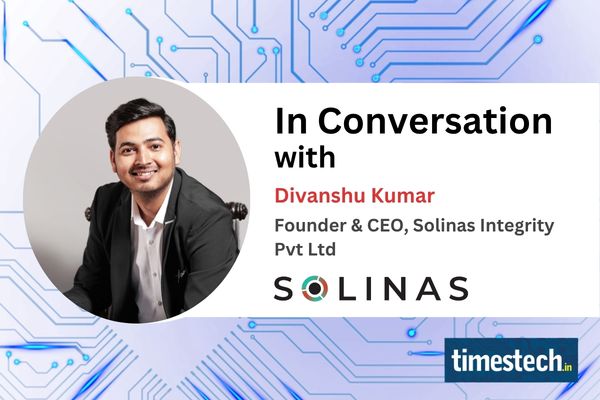
In an interview with Divanshu Kumar, Founder & CEO, Solinas Integrity Pvt Ltd, TimesTech explores how the IIT Madras-incubated deep-tech company is transforming underground water and sanitation infrastructure. Divanshu discusses Solinas’ journey from research to commercialization, the role of Endobot, HomoSEP, and Swasth AI in enabling predictive asset management, and the company’s vision of building an intelligent, data-driven utility ecosystem with a growing global footprint.
Read the full interview here:
TimesTech: Solinas evolved from an IIT Madras project into a leading deep-tech company. What were the biggest challenges in turning your research into a commercial technology business?
Divanshu: One of our biggest early lessons was realizing that a great product is not the same as a great business. As engineers and innovators, we naturally focused on building the best technology. But commercialization required us to think beyond the product—pricing, manufacturing, supply chains, deployment, service delivery, and building a sustainable business model.
The second challenge was developing a deep understanding of our customers. Municipal utilities and industries don’t invest in technology because it’s innovative; they invest in solutions that solve critical operational problems. We learned that creating value goes far beyond the hardware—it requires data, analytics, seamless deployment, training, after-sales support, and integration into existing workflows. That shift—from building products to solving customer problems—was fundamental to Solinas’ journey.
TimesTech: How do Endobot, HomoSEP, and Swasth AI work together to improve underground water and sanitation infrastructure?
Divanshu: Traditionally, water supply, sewerage, and stormwater systems have been managed as separate domains. In reality, they are deeply interconnected, and issues in one network often affect the others. At Solinas, we have built an integrated technology platform that enables utilities to manage these assets holistically.
Endobot performs intelligent inspections of water, sewer, and stormwater pipelines, providing detailed insights into the health of underground infrastructure. HomoSEP mechanizes the cleaning of septic tanks and manholes, eliminating the need for hazardous manual intervention. Swasth AI acts as the digital intelligence layer by integrating data from these systems, digitizing underground assets, and applying analytics and artificial intelligence to support predictive maintenance and data-driven decision-making.
Together, these technologies enable utilities to transition from reactive maintenance to proactive asset management, improving efficiency, reducing costs, and building more resilient infrastructure.
TimesTech: How has HomoSEP contributed to improving worker safety and reducing manual intervention in sanitation operations?
Divanshu: Many cities today face a technology gap. Smaller suction-cum-jetting machines often struggle with hardened sludge, while larger super sucker machines are expensive and inaccessible for many municipalities. HomoSEP was designed to bridge this gap.
Its bucket-grab mechanism removes solid waste that cannot be pumped, while its agitation system converts hardened sludge into a pumpable slurry for safe disposal and treatment. More importantly, the entire operation can be carried out remotely through a hydraulic boom and control console, eliminating the need for workers to enter or stand close to hazardous manholes.
By removing direct human exposure to toxic gases and unsafe confined spaces while improving cleaning efficiency, HomoSEP is helping cities move closer to eliminating manual scavenging through technology.
TimesTech: How have collaborations with major infrastructure and industrial companies shaped Solinas’ technology and product development?
Divanshu: Our collaborations have played a crucial role in validating and strengthening our technology. We began working with SUEZ in Coimbatore, and that relationship has since expanded to projects in Lucknow, Mangalore, and Kochi. Similarly, our partnership with OCW in Nagpur reinforced our credibility as a technology partner for large-scale water infrastructure management.
These partnerships exposed our solutions to diverse operating environments and customer requirements, giving us continuous feedback to improve our products, software, and deployment methodologies. They also helped us evolve from being a technology provider to becoming a trusted infrastructure partner. Today, many of India’s leading EPC companies, utilities, and industrial organizations rely on Solinas to improve the efficiency, safety, and intelligence of their underground infrastructure.
TimesTech: What is your long-term vision for Solinas, and what can we expect from the company in the coming years?
Divanshu: Our long-term vision is to become the trusted technology platform for utility asset management. We don’t see ourselves simply as a robotics company—we are building the intelligence layer for underground infrastructure, helping utilities make better decisions through robotics, AI, and data.
Over the coming years, we aim to integrate our platform with the broader utility ecosystem, including smart metering companies, SCADA providers, GIS platforms, and civil maintenance partners, to create a comprehensive and interoperable asset management solution. Alongside deepening our presence across India, we are expanding into the Middle East, Southeast Asia, and Europe, where aging infrastructure, water resilience, and climate adaptation are driving demand for intelligent infrastructure management.
Our ambition is to help utilities move from reactive operations to predictive, data-driven management, making water and sanitation systems safer, more efficient, and more sustainable worldwide.
Source:
https://timestech.in/solinas-is-transforming-underground-utilities-with-robotics-ai/