
Insights From Solinas
By Devi, Team Solinas
Sewer cleaning is one of the most critical parts of keeping a city safe, hygienic, and functional. For decades, cities have relied on traditional sewer cleaning methods such as manual cleaning, rodding, desilting, bucket cleaning, jetting, and emergency-based maintenance.
But urban sanitation systems are changing.
Sewer pipelines are becoming older, deeper, more congested, and more difficult to maintain. At the same time, cities are under pressure to reduce sewer overflows, protect sanitation workers, improve public health, and manage underground assets more efficiently.
This is why traditional sewer cleaning methods are no longer enough on their own.
The future of sewer and manhole cleaning must be safer, more mechanised, more preventive, and more data-driven. At Solinas Integrity, this belief drives our work in robotic sewer inspection, manhole cleaning robots, AI-based defect detection, and digital infrastructure intelligence.
What are traditional sewer cleaning methods?
Traditional sewer cleaning usually includes a few common methods.
1. Manual Scavenging
Manual cleaning involves workers physically removing waste, sludge, silt, and blockages from manholes, sewer lines, or confined spaces. In the most unsafe form, this can lead to manual scavenging, where workers are exposed directly to hazardous sewage environments.
This is one of the most dangerous and unsustainable practices in sanitation maintenance.
Inside sewer pipelines and manholes, workers may face toxic gases, low oxygen levels, infections, sharp waste, sudden flow changes, and confined-space risks. Even a short exposure in an unsafe manhole can become life-threatening.
2. Rodding and basic tools
Rodding involves using rods or basic tools to break or push blockages inside sewer pipelines. While this may solve small blockages temporarily, it does not show the actual condition of the pipe.
A blockage may not be just a blockage. It could be the result of silt accumulation, root intrusion, pipe deformation, joint displacement, cracks, corrosion, or a partially collapsed section.
3. Desilting and bucket cleaning
Desilting is used to remove accumulated silt, sludge, and solid waste from manholes and sewer lines. In many cities, this is still done after an overflow, complaint, or visible blockage.
This method may restore flow for the moment, but it does not always prevent the same issue from happening again.
When desilting is done without pipeline condition assessment, the city may clear the manhole but still miss the larger problem inside the connected sewer line.
4. High-pressure jetting
High-pressure jetting uses water force to clean sewer pipelines. It is useful in many cases, but when used without prior sewer inspection, it can miss serious issues such as cracks, collapsed sections, root intrusion, or recurring blockage points.
Cleaning without understanding the pipeline condition is like treating the symptom without diagnosing the problem.
The real-world impact of traditional sewer cleaning
Imagine a busy city road where a sewer line gets blocked. Wastewater starts overflowing from a manhole. The road becomes unsafe, traffic slows down, residents complain about the smell, and nearby shops are affected.
A cleaning team is called. The manhole is opened. Workers try to clear the blockage using rods, buckets, jetting, or manual cleaning methods. The flow may be restored for the moment.
But the city still may not know the actual reason behind the blockage.
Was it due to silt accumulation?
Was there a crack inside the sewer pipeline?
Was the pipe deformed?
Was there root intrusion?
Was the same location cleaned multiple times before?
Was there a hidden structural failure?
This is the biggest limitation of traditional sewer cleaning. It often solves the visible symptom, but not the invisible cause.
Without robotic sewer inspection or digital reporting, sewer cleaning can become a cycle of repeated temporary fixes. The same location may overflow again. The same complaint may return. The same road may be disrupted again. The same sanitation team may be sent back without enough information.
This also creates a public health concern. Sewer overflows can affect roads, communities, nearby water bodies, and disease prevention efforts, especially in dense urban areas where sanitation failures quickly impact daily life.
This is where traditional methods fall short. They address what is visible, but not always what is critical.
Why are traditional sewer cleaning methods no longer sustainable?
1. They put sanitation workers at risk
The biggest issue with traditional sewer cleaning is worker safety. Manual cleaning and unsafe manhole cleaning expose sanitation workers to toxic gases, infections, drowning risk, injuries, and long-term health hazards.
No worker should have to enter a hazardous manhole when safer alternatives such as a manhole cleaning robot, sewer cleaning robot, or mechanised cleaning system are available.
2. They are mostly reactive
Traditional sewer cleaning is often complaint-driven. A problem is noticed only after a blockage, overflow, foul smell, flooding, or public disruption.
This means cities spend more time responding to failures instead of preventing them.
Modern sewer maintenance should be preventive. It should identify weak zones, recurring blockage points, and high-risk sewer pipelines before they become emergencies.
3. They do not generate useful data
One of the biggest limitations of traditional sewer cleaning is the lack of digital records.
After a sewer line is cleaned, city teams may still not have clear information on:
Exact blockage location
Type of defect
Pipe condition
Severity of damage
Recurring risk areas
Cleaning history
Asset health score
Priority for repair or rehabilitation
Without data, it becomes difficult to plan budgets, schedule maintenance, or make long-term decisions for sewer asset management.
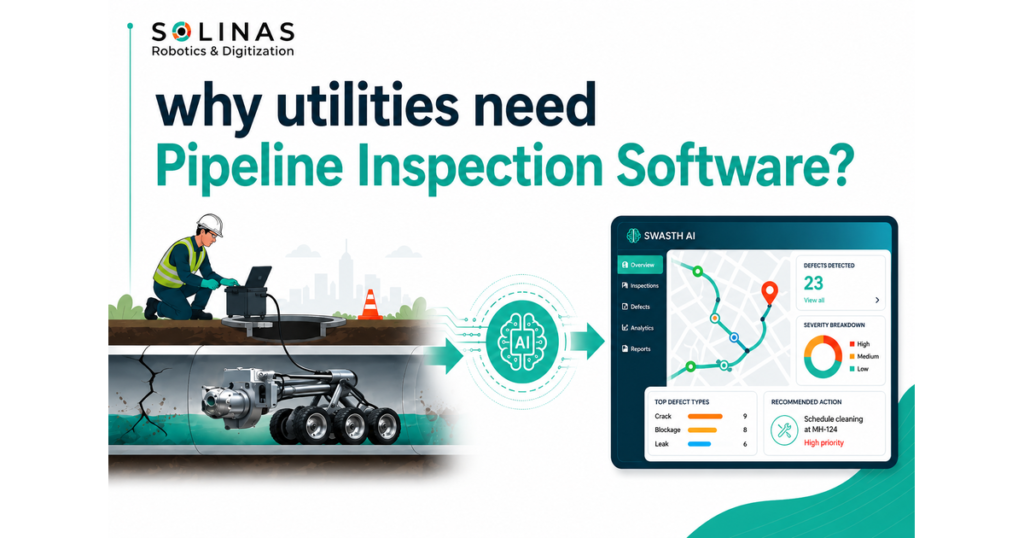
This is where robotic inspection and AI-based condition assessment can help. Solinas’ Swasth AI supports infrastructure teams with defect detection, pipeline condition assessment, GIS-based mapping, and decision-ready reports.
4. They increase repeated maintenance costs
A sewer pipeline may be cleaned again and again, but if the root cause is not identified, the problem will return.
For example, a line may keep blocking because of a damaged joint, root intrusion, settled silt, or pipe deformation. If the city only clears the blockage without inspecting the pipeline, the same location may need repeated cleaning.
A one-time manual cleaning activity may look cheaper at first, but repeated emergency maintenance becomes expensive over time.
5. They can damage the environment
Sewer overflows can contaminate roads, stormwater drains, lakes, rivers, and groundwater. Poorly maintained sewer pipelines can also create public health risks and affect the surrounding environment.
6. They are not suitable for modern cities
Today, cities are moving towards smart infrastructure, GIS mapping, digital twins, AI-based monitoring, and preventive maintenance.
Traditional sewer cleaning methods alone cannot support this transition. They need to be replaced or supported by safer and smarter alternatives such as robotic sewer inspection, sewer cleaning robots, manhole cleaning robots, and AI-enabled infrastructure intelligence.
Alternatives to traditional sewer cleaning
The good news is that cities now have better alternatives. Sewer and manhole cleaning can be made safer, faster, and more intelligent through mechanised systems, robotics, AI, and digital asset management.
1. Manhole cleaning robots
A manhole cleaning robot is designed to reduce the need for manual entry into manholes. It can support sludge removal, cleaning, and maintenance activities while keeping sanitation workers outside dangerous confined spaces.
Solinas’ HomoSEP is a mechanised sanitation solution developed to support safer manhole cleaning and reduce human exposure to hazardous sewer environments. For users searching for HomoSEP sewer solutions, HomoSEP represents a practical step towards mechanised manhole cleaning and safer sanitation work.
2. Robotic sewer inspection
Before cleaning a sewer pipeline, it is important to understand what is happening inside.
Robotic sewer inspection systems can enter sewer pipelines and capture internal visuals. These systems help identify blockages, cracks, root intrusion, corrosion, joint displacement, deformation, and other defects.
Solinas’ Endobot supports safer and more reliable inspection of underground pipelines, helping teams move from guesswork to evidence-based maintenance.
3. Sewer cleaning robots
A sewer cleaning robot can enter sewer pipelines or confined spaces and support cleaning operations without requiring unsafe human entry.
Robotic systems help reduce worker exposure, improve cleaning efficiency, and support safer sewer maintenance. They are especially useful in difficult, hazardous, or inaccessible locations.
4. AI-based defect detection
Inspection data becomes more powerful when combined with AI.
AI can help detect, classify, and prioritise defects faster. Instead of manually reviewing long inspection videos, utilities can use AI-supported tools to identify problem zones and generate structured reports.
With Swasth AI, Solinas enables infrastructure teams to convert inspection data into actionable insights for sewer maintenance, condition assessment, and repair planning.
5. GIS-based sewer asset mapping
Many cities still do not have accurate digital maps of their underground sewer pipelines and manholes. This makes maintenance difficult and increases dependency on local memory or manual records.
GIS-based mapping helps cities understand:
- Where sewer assets are located?
- Which manholes are high-risk?
- Which pipelines face recurring blockages?
- Which areas need priority cleaning?
- Which zones require rehabilitation?
This supports better planning, faster response, and long-term sewer asset management.
The future of sewer cleaning is safer and smarter
Traditional sewer cleaning methods helped cities manage sanitation systems for many years. But today, they are no longer sustainable on their own.
The future must move towards:
- Elimination of unsafe manual scavenging
- Reduced dependency on manual cleaning
- Sewer cleaning robots
- Manhole cleaning robots
- Mechanised manhole cleaning
- Robotic sewer inspection
- AI-based defect detection
- GIS-based sewer asset mapping
- Preventive sewer maintenance
- Data-driven sanitation infrastructure management
This is the shift from reactive sewer cleaning to intelligent sewer infrastructure management.
At Solinas Integrity, we are working to make underground infrastructure safer, cleaner, and more sustainable through robotics, AI, and field-ready technologies.
To learn more about Solinas’ work in robotic pipeline inspection, AI-based infrastructure digitization and mechanised sanitation solutions, visit Solinas Integrity.
FAQ
How can robotic sewer cleaning improve municipal sanitation services?
Robotic sewer cleaning enables municipalities to clean sewer networks more efficiently, reduce sewer overflows, improve response times, and ensure safer maintenance operations across the city.
Can robotic sewer cleaning be integrated into existing municipal maintenance operations?
Yes. Robotic cleaning systems can complement existing jetting, suction, and sewer maintenance equipment, allowing municipalities to enhance their current operations without major infrastructure changes.
Is robotic sewer cleaning suitable for Smart City projects?
Absolutely. Robotic sewer cleaning aligns with Smart City initiatives by introducing technology-driven asset management, worker safety improvements, and data-based decision-making for urban infrastructure maintenance.
How does robotic sewer cleaning support worker safety regulations?
Robotic systems eliminate the need for workers to enter hazardous manholes and septic tanks, helping municipalities comply with safety guidelines and reduce occupational risks.
Can robotic systems clean both sewer lines and stormwater drains?
Yes. Depending on the deployment requirements, robotic cleaning solutions can be used for sewer networks, manholes, stormwater drains, and other underground utility assets.
What types of waste can robotic cleaning systems remove?
Robotic cleaning systems can remove:
- Sludge
- Silt
- Plastic waste
- Stones
- Sediment accumulation
- Construction debris
- Organic waste