
Insights From Solinas
Surprises? Contamination incidents are symptoms
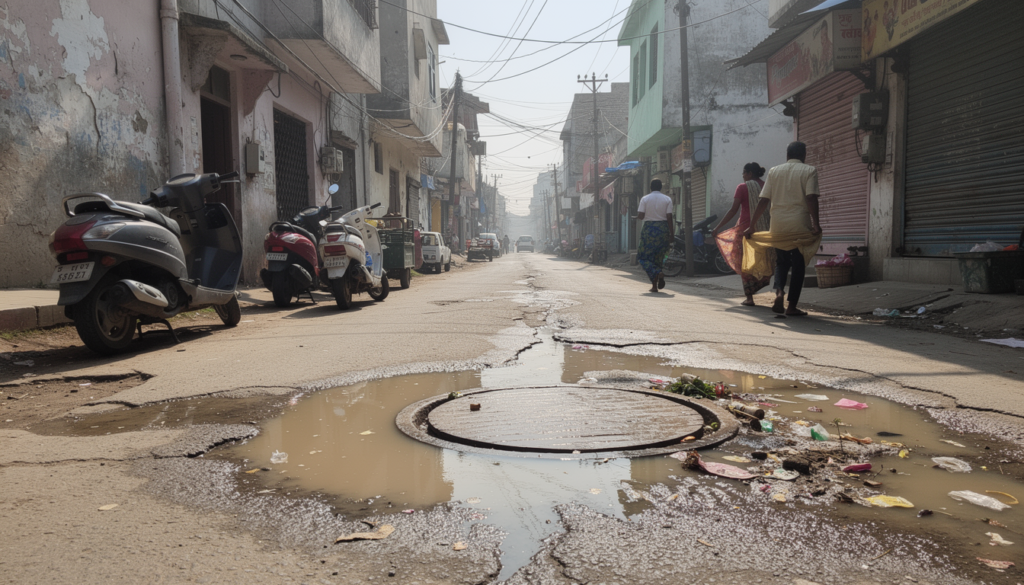
Water contamination linked to sewer ingress has existed in Indian cities for decades. The way this issue manifests hasn’t changed. Rather, the problem has now become about scale and visibility of failure.
In early 2026, parts of Indore experienced a severe public health crisis after sewage entered the drinking water network, leading to multiple deaths and more than a thousand reported illnesses, as detailed in the reporting on the Indore water contamination incident. Investigations pointed to damaged pipelines and sewage entering drinking water lines, a failure that remained underground until it reached households.
Indore is not an isolated case. High turbidity and faecal contamination reported in Cuttack and Bhubaneswar led to safety advisories and emergency measures, while urban surveys in Bhopal highlighting concerns over water safety and intermittent supply revealed broad distrust in piped water quality. In Greater Noida, residents reporting vomiting and diarrhoea after sewage mixed with drinking water, fears arose of comparable public health consequences.
Collectively, these events indicate a common issue throughout urban India: deteriorating underground infrastructure, insufficient separation of water and sewer systems, and poor monitoring of pipeline conditions.
Intermittent supply is worsening contaminations
Many Indian cities rely on intermittent water supply. When pipelines run empty or at low pressure, they turn vulnerable to contamination.
Cracks, faulty joints, and illegal connections permit contaminated groundwater or sewage to enter water lines during pressure drops. This process has been documented in global research on contamination risks in intermittent water distribution systems. Studies indicate that negative pressure events greatly raise the likelihood of pathogen intrusion into drinking water networks.
This risk intensifies because of the high volume of untreated wastewater in Indian cities. Analyses showing that a large share of urban sewage remains untreated before entering the environment emphasize how sewer overflows and leaks amplify the contamination danger to nearby water systems.
When sewer networks fail, the tight physical proximity of water and sewer lines in dense urban areas heightens cross-contamination risks. After contamination occurs, responses usually prove reactive, like flushing, chlorination, and emergency shutdowns, instead of fixing the core structural issues in the network.
Where is the real gap?
What distinguishes recent incidents is the loss of buffers. Higher population density means a single failure can affect thousands of households simultaneously. Increased public scrutiny has made these failures harder to ignore, placing pressure on city administrations to move beyond crisis management.
Treatment plants and end-point testing remain essential, but they are no longer sufficient on their own. Preventing contamination requires understanding the condition of underground water and sewer pipelines, identifying vulnerabilities early, and acting before failures surface at the tap.
The future safety of urban water in India will depend not only on what is treated above ground, but on how effectively cities manage the infrastructure they cannot see.