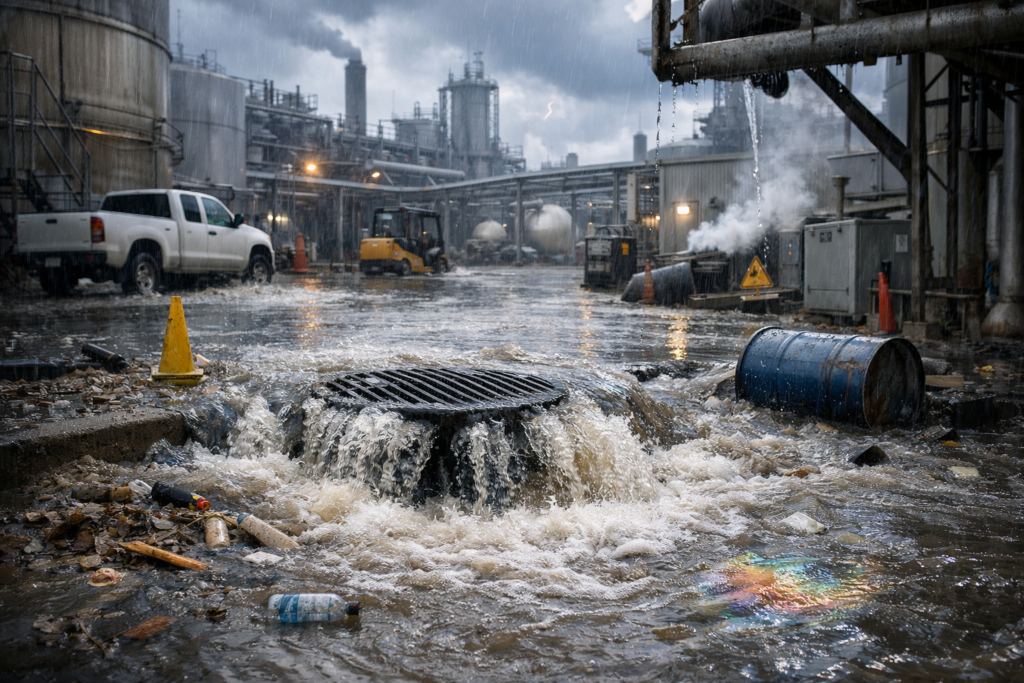
When people talk about running an industrial facility, they usually talk about how many things are being made, how often the equipment is working, safety checks, and how many people are working there. People don’t often talk about stormwater systems in those talks. Not because they’re not important, but because they usually stay hidden. They work quietly underground for long periods of time, often for decades, without much notice.
The issue is that these systems don’t send out early warnings. When a pump has trouble, it makes noise. An alert goes off when a motor runs. Stormwater drains don’t do either. They still look “fine” until a heavy rainstorm pushes them past their limit. And when that happens, the effects are felt right away and all over the place.
Operations are the first to feel the effects of drainage failure.
People often ignore flooding inside an industrial site as bad weather. In reality, it usually happens because things build up slowly in the drainage system. The effective diameter of stormwater lines slowly gets smaller because of silt, leaves, industrial waste, and other trash. This doesn’t happen when it’s only a little rain. It shows up when it rains a lot.
When capacity is lost, daily operations are affected very quickly.
Access roads can flood without warning, which makes it harder to get in and out.
As drivers steer clear of waterlogged areas, the movement of vehicles inside slows down.
When trucks can’t get to the docks on time, loading and unloading schedules get messed up.
These problems show up later as missed deadlines or targets, but stormwater infrastructure is rarely to blame.
The risks to safety go up quietly
It’s easy to underestimate the dangers of standing water. It’s harder to see open chambers, uneven surfaces, and hidden pits. There is a higher chance of slips and falls, especially for workers who are moving between buildings or driving vehicles.
Utilities are another problem. Stormwater lines and electrical cables and communication ducts often run through the same areas. When water backs up, it doesn’t just stay in the drain. It gets into other areas around it. In these situations, electrical problems, unexpected shutdowns, and system trips are not uncommon.
The situation gets even more complicated when industrial oils or chemicals are involved, which raises environmental and compliance issues.
Damage that lasts a long time happens slowly at first, then all at once.
Damage from drainage usually gets worse over time. Foundations get weaker when they are always wet. Steel reinforcement rusts more quickly. The soil underneath equipment bases stays wet, which makes them less stable.
Sensitive electronics also get hurt. Humidity can damage control panels, sensors, and automation systems over time. Their performance slowly gets worse, and failures happen later, usually without a clear link to drainage.
Blockages can cause pressure to rise inside the pipes, which can crack joints or make weak parts fall apart. When that happens, fixing things is usually not easy. After that, there are emergency excavations, production delays, and high costs.
Not fixing things after they happen
One reason stormwater problems keep happening is that no one owns them. Because the system is out of sight, maintenance is often put off because responsibility is shared between departments. Only after flooding or failure happens does action happen.
Some facilities are starting to change the way they do things. Teams can actually see what’s going on inside stormwater lines by using inspection methods that don’t get in the way. Before they become emergencies, you can see sediment buildup, deformation, and damage that has already started.
This lets you plan maintenance instead of doing it quickly. The system stays reliable when it is needed most, and capacity is slowly restored.
Final thought/Conclusion
Managing stormwater isn’t just about following rules or making sure it drains properly. It has a direct impact on safety, the life of assets, and the stability of operations. The cost of ignoring these systems keeps going up as the weather patterns become less predictable.
Facilities that see stormwater infrastructure as a key asset, not just an afterthought, are better able to protect their people, their operations, and their long-term success.