
Insights From Solinas
India has made significant progress in sanitation infrastructure, worker rehabilitation and mechanised cleaning. Safety equipment and Manhole Cleaning Robots are becoming available across cities.
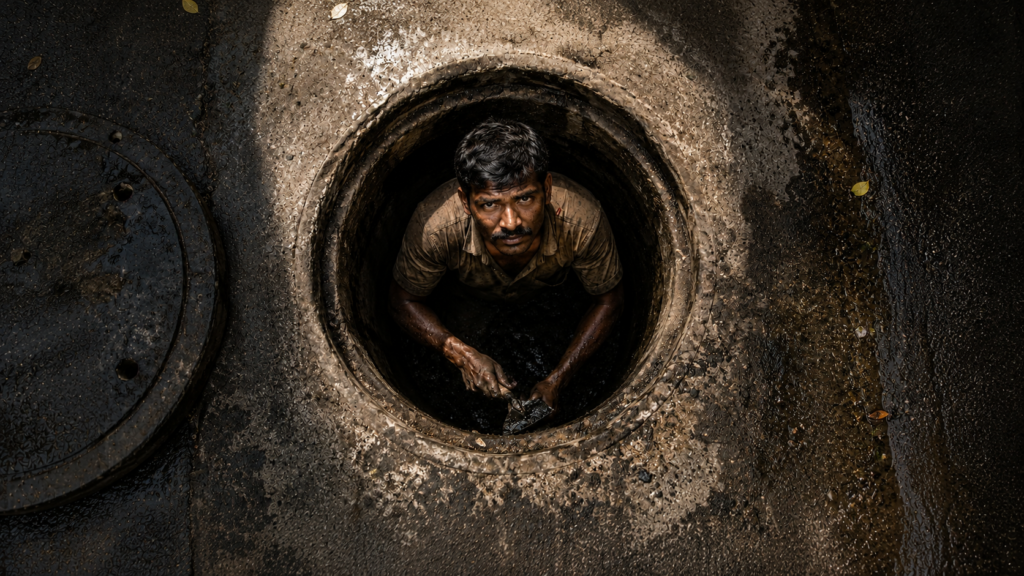
However, a serious question remains: Why are sanitation workers still entering hazardous sewers and septic tanks?
According to a July 2026 Lok Sabha response published by the Press Information Bureau, 332 sanitation workers lost their lives while undertaking hazardous cleaning of sewers and septic tanks in 18 States and Union Territories between 1 January 2021 and 30 June 2026.
Every number represents a worker, a family and a life that should have been protected.
The challenge is not simply the absence of technology. It is about ensuring that the right technology, trained operators, maintenance support and safe operating procedures are available at every location where sanitation work takes place.
Manual Scavenging and Hazardous Cleaning
The terms “manual scavenging” and “hazardous sewer cleaning” are often used interchangeably. However, they do not always mean the same thing under the law.
Manual scavenging commonly refers to the manual handling of human excreta from insanitary latrines, open drains, pits and similar sanitation systems.
Hazardous cleaning refers to workers manually entering sewers or septic tanks without the prescribed safety equipment, cleaning devices and precautions.
The Prohibition of Employment as Manual Scavengers and their Rehabilitation Act, 2013 prohibits manual scavenging and hazardous cleaning. The Government of India has also repeatedly reaffirmed its commitment to eliminating these practices through legal enforcement, rehabilitation and mechanised sanitation.
Why Sewer & Septic Tank Entry Is Extremely Dangerous?
A sewer or septic tank is a confined space. From the outside, it may appear to be only a blocked manhole or an overflowing tank. Inside, however, conditions can change within seconds.
Toxic gases may be invisible
Sewers and septic tanks can contain gases such as hydrogen sulphide and methane. Oxygen levels can also fall dangerously low.
A worker may not be able to see or smell the danger before entering. Exposure can cause dizziness, unconsciousness or death within a short time.
Sludge becomes hard and difficult to remove
Septic tanks and manholes are not always filled with liquid waste that can be removed easily using suction.
Over time, sludge can become heavily compacted. It may contain silt, grease, plastic, cloth, construction debris and other solid materials. This hardened material cannot always be removed directly by a conventional suction machine.
When equipment is unable to break or loosen the sludge, workers may be asked to enter and clear it manually.
Every sanitation site is different
India’s sanitation infrastructure includes old sewer networks, deep manholes, unplanned pipelines, septic tanks of different sizes and systems located inside narrow streets.
Large vehicles cannot reach every location. A machine that works on a wide main road may not be suitable for a congested residential lane.
This means mechanisation cannot follow a one-machine-fits-all approach.
Why Does Human Entry Continue When Technology Exists?
Robotic and mechanised cleaning technologies already exist. Yet the presence of a technology does not automatically make it available at every worksite.
Several practical factors influence whether a sanitation team can complete a cleaning operation without human entry.
Mechanisation has not reached every worksite
Conventional equipment may not solve every blockage
Narrow streets restrict vehicle access
Emergency pressure can lead to unsafe decisions
Buying equipment is only the beginning
Workers need to be part of the transition
India Is Building a Mechanised Sanitation Ecosystem
The Government of India has introduced important measures to strengthen worker safety and accelerate mechanisation.
The National Action for Mechanised Sanitation Ecosystem, or NAMASTE, brings together mechanised cleaning, worker identification, occupational safety, skill development, healthcare and livelihood support.
According to the Government’s July 2026 update on the NAMASTE Scheme,
89,915 sewer and septic tank workers had been validated under the programme.
A total of 87,037 PPE kits had been distributed,
Health cards had been issued to 76,845 workers and
753 Emergency Response Sanitation Units had been equipped with modern safety devices.
These measures show that the shift towards safer sanitation is already underway.
The next stage is to connect national programmes with field-level requirements. States, ULBs, implementing agencies, CSR partners, technology companies and sanitation workers must work together to ensure that mechanisation reaches every critical location.
What Complete Mechanisation Should Look Like?
Eliminating hazardous human entry requires more than replacing one manual activity with one machine. Cities need a complete mechanised sanitation workflow.
This should include:
Identification and mapping of sewers, manholes and septic tanks
Regular cleaning schedules instead of only emergency responses
Gas detection before any sanitation operation
Equipment for inspection, sludge cutting, homogenisation, suction and jetting
Compact systems for narrow and inaccessible locations
Trained operators and supervisors
Preventive maintenance and service support
Emergency rescue procedures
Digital records of cleaning operations and equipment use
Different sanitation conditions may require different combinations of equipment. The objective should be clear: no worker should enter a hazardous confined space to perform a task that can be completed mechanically.
How Does Homosep Sewer Support No-Human-Entry Cleaning?
Homosep Sewer is a manhole cleaning robot developed by Solinas to clean manholes and septic tanks without requiring workers to enter them.
The system is designed to address a common gap in conventional cleaning: hardened and compacted sludge.
Its patented homogenisation mechanism cuts and loosens settled waste, converting it into a pumpable slurry. This allows the material to be removed through suction equipment without manual handling.
HomoSEP Sewer also supports remote operation and can be used with toxic-gas monitoring and visual inspection systems.
The purpose of the technology is not merely to automate cleaning. It is to create a safer role for sanitation workers as trained robotic operators.
From Technology Availability to Technology Readiness
India does not need to wait for sanitation technology to be invented. Many of the necessary technologies are already available.
The larger task is to make them operationally ready.
Technology alone is not enough; municipalities also need structured deployment, trained operators and clear safety protocols. This is why municipal corporations are adopting robotic sewer cleaning as part of safer, more efficient sewer-maintenance systems.
Government programmes can provide direction and institutional support. ULBs can identify local requirements and build response capacity. CSR partners can help accelerate deployments and worker training. Technology providers can adapt equipment for Indian field conditions. Sanitation workers can become skilled operators who lead the transition on the ground.
The Goal Is Zero Human Entry and Zero Fatalities
The 332 deaths reported between January 2021 and June 2026 remind us why the transition must continue with greater speed and wider collaboration.
The next step is to ensure that these systems reach every city, town and sanitation team that needs them.
When government institutions, municipal bodies, CSR organisations, technology companies and trained workers move together, India can make hazardous human entry a practice of the past.
Because the true measure of sanitation progress is not only how efficiently a sewer or septic tank is cleaned.
It is whether every sanitation worker returns home safely.