
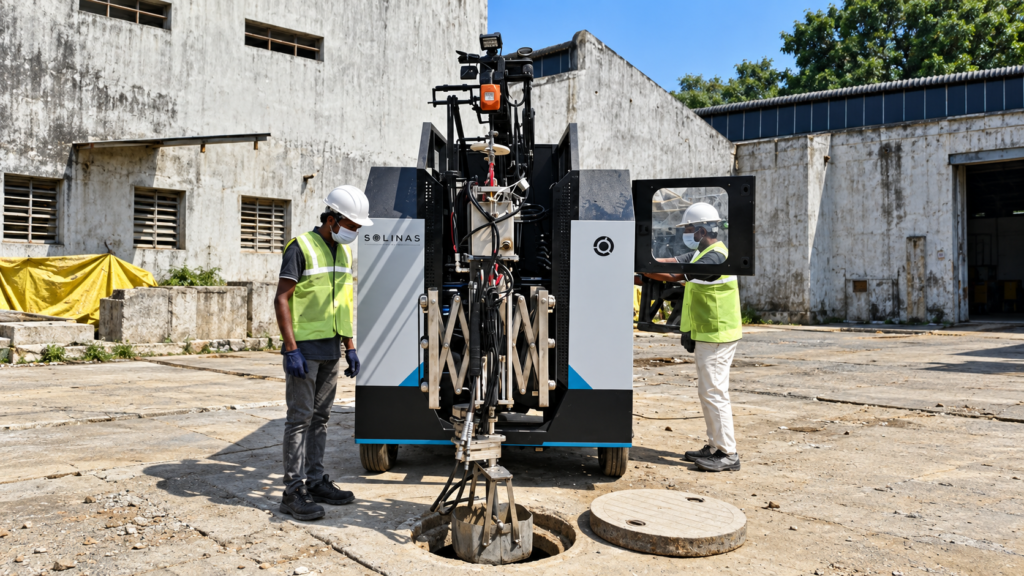
Why Is Homosep Sewer the Reliable Sewer Cleaning Robot for Indian Cities?
Homosep Sewer brings together sludge-breaking blades, interchangeable cleaning attachments, surface-controlled operation, and waste storage options to address different municipal manhole cleaning needs.
Supported by deployments across 15 states, operator training, maintenance, and ongoing field support, it helps cities carry out safer, more consistent, and repeatable manhole cleaning.
For Indian cities seeking wider mechanized cleaning coverage, the value lies in how these features work together. They address the material inside the chamber and the practical work of removing it from the site.
1. Patented Blades Break Down Sludge Before Extraction
When settled sludge becomes too compact for suction alone, Homosep Sewer’s patented homogenizing blades break it down into a pumpable slurry. The prepared material can then be removed using the suction system in the selected configuration. This combines sludge preparation and extraction, with operators controlling the cleaning process from the surface.
For a deployment team, removing liquid is only one part of manhole cleaning. Settled sludge often hardens inside the chamber, making suction difficult and creating one of the most common reasons for manual entry. This is one reason manhole scavenging continues despite the availability of manhole cleaning robots.
For suitable cleaning conditions, this enables 100% no-manual-entry sludge removal, with the operation carried out from the surface.
The next chamber may contain a different problem. A blade suited to sludge is not the tool required to lift debris.
2. Swappable Attachments Help Us Respond to Mixed Waste
Homosep Sewer uses different attachments for different waste materials. Its homogenizing blades break down hardened sludge, while the grabbing bucket lifts suitable solid waste such as plastic waste, stones, and accumulated debris. Attachment selection depends on the material encountered, its size and weight, and the access available inside the chamber.
This matters when a municipal team has several locations to cover. Equipment that can perform different cleaning tasks gives the deployment team more options within the same platform.

3. Surface Operation Keeps Worker Safety Central
Homosep Sewer is operated from outside the manhole, with cameras and a toxic-gas sensor among its monitoring features.
For us, this is a central reason to deploy it: the cleaning task can be organized around keeping the operator above ground.
The responsibility extends to the surrounding work area. An open manhole, moving vehicles, hoses, and extracted waste all need attention. Equipment capability and a well-managed site have to work together.
If the robot cannot complete a particular task, the next step is to reassess the method. The pressure to finish a job should never become a reason to improvise unsafe human entry.
4. Stability and Extended Reach Support Deeper Cleaning
Reaching the waste is important. Being able to position the cleaning equipment for the task matters just as much.
Homosep incorporates a stabilizer mechanism, with vertical coverage of up to 20 meters.
From a deployment perspective, stability belongs in the same discussion as depth. The tool needs to work in the intended position, with the equipment set up correctly for the chamber and its surroundings.
For a city with manholes of different depths and layouts, this makes reach and positioning practical selection criteria. We still need to assess the opening, internal obstructions, ground conditions, and vehicle access. Maximum vertical coverage does not mean that every cleaning function, including suction, has identical performance at that depth.
5. Cleaning, Storage, and Transport in One Deployment
Homosep can combine cleaning, onboard storage, and transport in an integrated vehicle configuration, with sludge tank options ranging from 2,000 to 6,000 liters.

Manhole cleaning does not end when waste is removed from the chamber. It must also be stored, transported, and taken to the appropriate receiving facility. For suitable waste and site conditions, an integrated configuration can reduce dependence on separate vehicles, simplify scheduling, and provide a clearer plan for collection and disposal, particularly on busy city roads and near facility entrances.
Read more about why traditional sewer cleaning methods are no longer sustainable.
6. Deployments Across 15 States Bring Wider Field Experience
Homosep Sewer has been deployed across 15 states in India, giving the platform field experience beyond a single city or pilot.
One example is our work with the Secunderabad Cantonment Board through a project funded by Wells Fargo. Narrow lanes and congested neighborhoods made access difficult for large cleaning machines. Solinas deployed a Homosep unit and trained 57 sanitation workers to operate it.
This is where deployment becomes more than selecting a cleaning tool. The equipment has to suit the location, and the people responsible for using it need the training to carry out the work forward. It is a practical example of why access and operator readiness belong in the same conversation.
7. Site Assessment Helps Cities and Facilities Plan the Work
A municipal road, an apartment entrance, and a factory utility area each place different demands on a cleaning team.
Solinas offers site assessments and cleaning services based on project requirements.
For an industrial utility or facility manager, the discussion should start with what the drain carries, where it connects, and when the work can take place. Process discharge requires a specific suitability assessment; a machine’s use in sewage cleaning does not establish compatibility with every type of industrial waste.
Our priority in deployment planning is to resolve those dependencies before equipment arrives. It gives the client a clearer working window and helps the team arrive prepared.
8. Reliable Cleaning Depends on the People Supporting the Machine
A city needs equipment it can use repeatedly. That makes operator readiness, maintenance, and support part of the deployment discussion.
Our Noida project offers another example. Since May 2025, Solinas has worked with the Noida Authority on a project supported by the HCL Foundation through CSR funding. The project account records that more than 60 workers have been trained to use Homosep.
For a city, that training helps build a team capable of using the equipment as part of its cleaning work. From the deployment side, the focus has to include the people who will operate the machine after it arrives.
From our perspective, a useful handover must leave the assigned team clear about operating the equipment, carrying out routine checks, recognizing a problem, and knowing when to stop.
Why We Put Homosep Sewer Forward for Indian Cities?
The case for Homosep Sewer rests on a combination of practical capabilities:
1. Patented sludge-breaking blades,
2. Interchangeable cleaning attachments,
3. A stabilizer mechanism,
4. Surface operation
5. Options that bring cleaning, storage, and transport together.

Deployment across multiple states adds field experience to that combination.
Our responsibility is to connect those capabilities to the job in front of us. That means a suitable configuration, a prepared team, workable site arrangements, and a clear understanding of what completion looks like.
Calling a robot the best and reliable should be backed by how well it serves the location and the people responsible for it. That is the standard we would apply to every Homosep deployment.