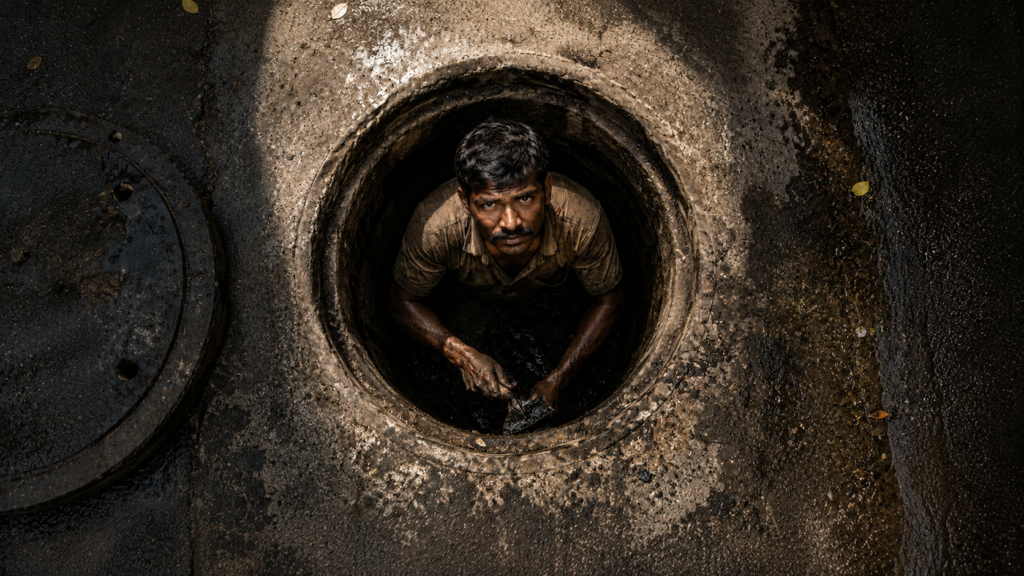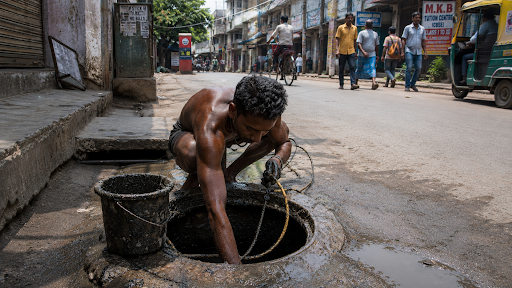
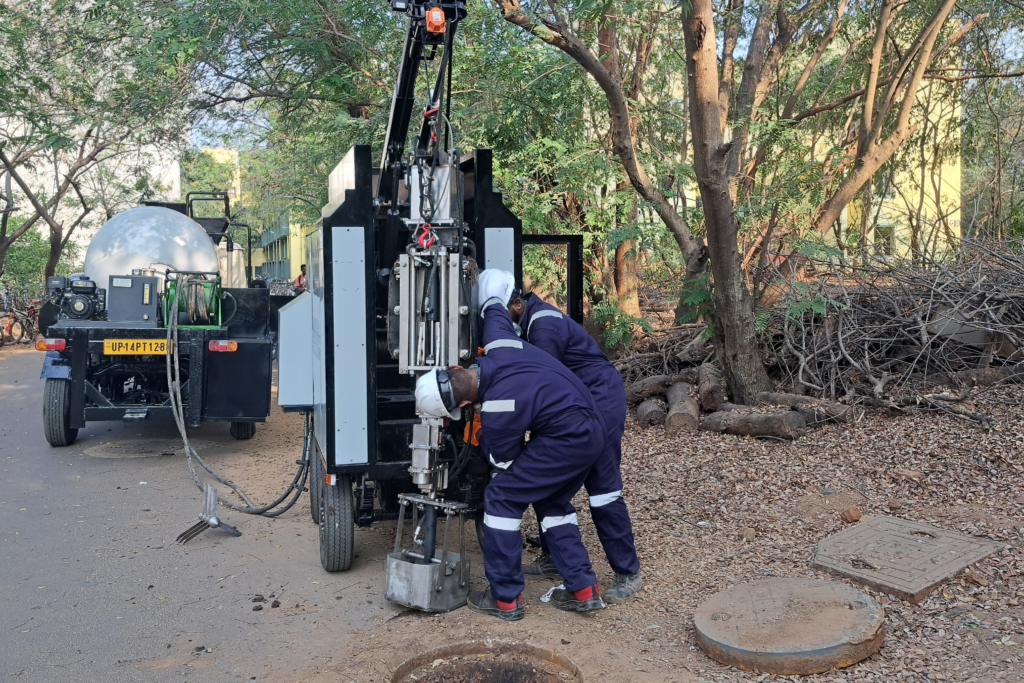
This week India observed World Toilet Day. On that same day in 2020, the MoHUA launched the Safaimitra Suraksha Challenge to ensure that no cleaner’s life is lost again to the dangers of cleaning sewers or septic tanks.
Six years on, that objective has a new ally in the form of a wave of innovation. Drones are now flying into sewers. Robots are being designed to operate inside pipes for days. Sensors can be used to alert you to the presence of toxic gas prior to the lid even being lifted.
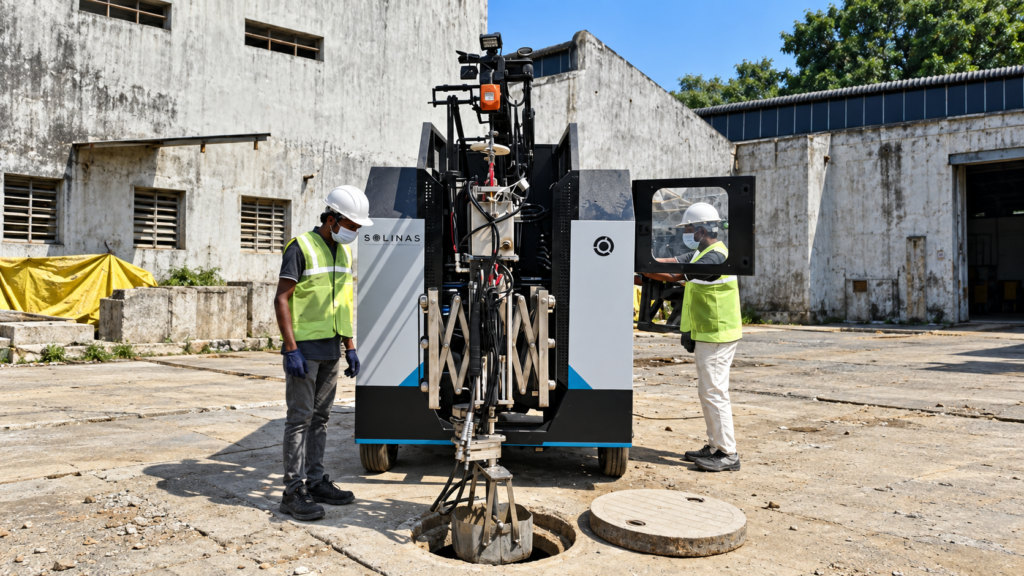
At Solinas, we’re building these tools for Indian streets every single day. This post is about the innovations that are transforming manhole cleaners around the world, what we’ve built this year, and where the technology is headed next.
From manhole to machine hole
India has laid out a very clear national objective: it’s machines, not people, that should be doing the work down below. Three programmes have turned that objective into a clear requirement for new technology.
The Safaimitra Suraksha Challenge (2020) was a national-level competition which asked the cities to mechanise all their sewer and septic tank cleaning. It was launched in 243 cities. Indore, Navi Mumbai, Nellore and Dewas were among the first winners, and 41 “lighthouse cities” were recognised for their progress.
NAMASTE (2023): the National Action for Mechanised Sanitation Ecosystem provides safety training, PPE and health insurance alongside capital subsidies to enable sanitation workers to own the machinery.
Support for deep tech startups: the DST incubators at institutions like IIT Madras have been instrumental in taking homegrown sanitation robots from the lab to the street.
Policy has created the demand. Engineers now have a critical role in translating these objectives into practical solutions.
What the rest of the world is testing?
All around the world, engineers are converging on one idea: get the sensor, get the camera, get the robot, and never get the person. Five of these are particularly notable in 2026. Most of them are still research prototypes, designed for the vast, well-mapped sewers of Europe and North America. They’re all pointing the way forward.
1. Drones that fly into sewers
Caged, collision-tolerant drones now fly in the sewers (where GPS doesn’t work). They’re using LiDAR to map the tunnels as they go and are continuously monitoring for hazardous gases so the survey teams can stay right on the surface rather than having to go in.
2. Robots designed for continuous sewer monitoring
In the UK a £1.8m project (funded by Ofwat’s Water Breakthrough Challenge) is developing “Pipebot Patrol”, which is an autonomous robot that will be permanently resident in the network, inspecting it continuously and triggering alerts when blockages are starting to form.
3. “Thinking” robots that fix as well as find
Europe’s PIPEON project (led by Tallinn University of Technology with around €8m of EU funding and 12 partners) is developing robots that will map sewers, install sensors and clear blockages autonomously. They operate completely without GPS or signal and so have to run their own machine learning on very small onboard computers and be able to work for days on their own.
4. Smart manholes that warn before anyone opens them
Low-cost IoT sensors are providing early warning right at the manhole. In 2026, researchers at VIT Chennai published a portable gas sensing system that provides real-time alerts on toxic gases inside manholes. When combined with level sensors, smart manholes can be used to trigger an alert for an overflow or for a hazardous atmosphere before the crew even get there.
5. Robots that repair without digging
Repair is going fully robotic now. AI robots can now be used to rehabilitate pipes from the inside, with a much smaller crew and minimal surface disturbance. Rehabilitating from the inside leads to fewer future blockages and, hence, fewer reasons to send anyone down.
Why does this matter for India?
These advances confirm the trajectory that Indian engineering is already on. One of the persistent challenges in Indian sanitation infrastructure is the issue of compacted sludge and mixed waste in the narrow manholes and septic tanks (many of which are completely uncharted). Our robots were designed around that very problem from day one and are already in operation in over 30 Indian cities.
Built in India, for India: Solinas in 2026
We believe that effective sanitation technology must be designed around the conditions in which it operates. Our prototype taught us that the hard way. Feedback from sanitation workers in Chennai revealed the limitations of our initial prototype.
Their practical knowledge helped us redesign the technology to address real-world cleaning challenges. They asked us if we’d ever actually seen a tank being cleaned, and we hadn’t, so we went back and redesigned it on the basis of what they showed us.
That field-first approach shaped a big year:
Investment in R&D: In August, we closed a $5.5m Series A led by Hero Enterprise Partner Ventures for R&D and expansion.
Made in India: around 80% of the cost of each robot is now local, and our Chennai facility is currently able to build 100-120 robots per year. We’re looking at a second plant in either Maharashtra or Delhi to double that output.
Reach: our robots are now operating in over 30 Indian cities, and we’ve started to serve markets in the Middle East and Southeast Asia.
Public partnerships: Chennai Metrowater engaged us for a two year ₹3.99cr robotic pipeline inspection project following on from their 2023 pilot. The use of footage from within the network has effectively replaced a lot of the exploratory trial pits.
As our co-founder Moinak Banerjee points out, only a company that has the actual local R&D can build robots that are going to work in the Indian environment. India’s narrow lanes, mixed waste and varied manhole configurations demand technologies adapted to local operating conditions.
1,000 manholes, and no one went inside.
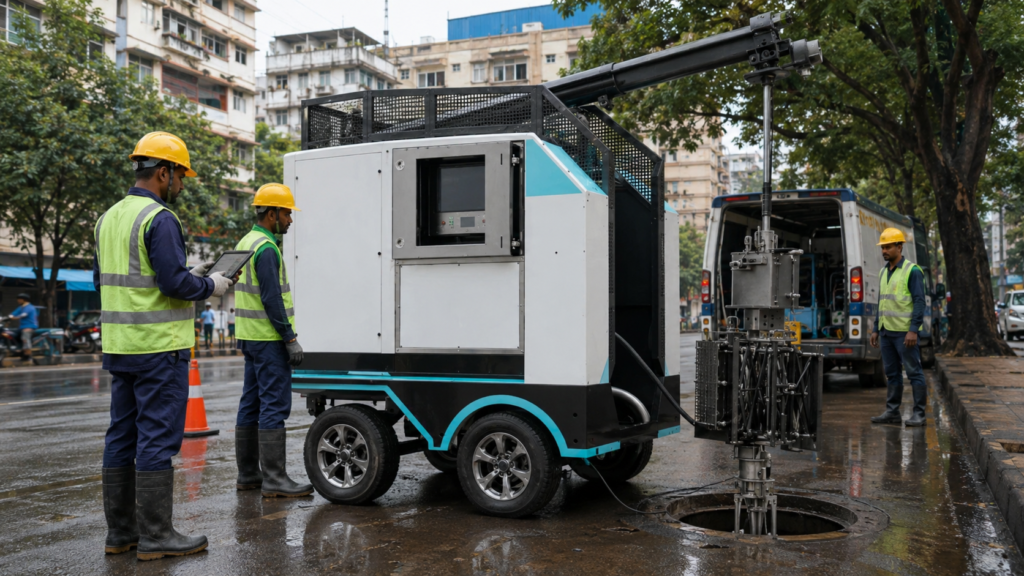
In Noida, we were working with the Noida Authority and the HCL Foundation’s CSR programme, and our Homosep sewer robot had cleaned 1,015 manholes by September 2026 with absolutely no one going into a manhole at all.
Approx. 6,000 households are served by the cleaned network.
30 local sanitation workers have been trained to operate the robots.
10 to 12 manholes a day is the rate at which the crews are now able to work, which would see us hit the 1,000 figure in about 100 working days.
The sites were far from easy. We encountered hard sludge, deformed manholes, restricted access, and a significant accumulation of solid waste. Homosep’s blades would break down the compacted sludge into a slurry, which the suction could then take away, and a grabber bucket would then lift the debris out. Every one of those 1,015 cleans was a job that would have seen a sanitation worker otherwise.
What comes next?
The next decade of sanitation tech is all about connecting these inventions into one system. We see four shifts coming:
From one-off jobs to always-on networks. Robots that go down the pipes and sensors that sit in the manholes will detect a blockage as it’s forming so cleaning can happen on schedule rather than as an emergency.
From single machines to robot teams. A drone or crawler will be surveying the line, a cleaning robot will be clearing the manhole, and a repair robot will be doing the pipe repair, all from the surface.
From cloud to onboard intelligence. Similar to the autonomous technology being developed through Europe’s PIPEON project, where the next gen will be making decisions down in the pipe where there’s no signal.
From major cities to smaller towns. The biggest need is in the tier 2 and tier 3 towns. You need compact, affordable machines and service models that are locally supported and which allow the smaller towns to pay per job rather than buy a full fleet.
At the heart of this transformation are sanitation workers. Their experience and expertise remain essential as they transition towards operating robotic systems from above ground.
Building it together
No single company, city or ministry will finish this alone. The fastest progress comes when government programmes, municipal bodies, CSR partners, researchers and technology makers pull in the same direction.
We would like to hear from:
Municipal corporations and utilities looking to make no-entry cleaning the standard across their networks
CSR teams and foundations who want to fund robots and operator training in towns that need them most
Research institutions working on autonomy, sensing or materials for harsh underground environments
Housing societies, campuses and industrial parks that want their own tanks and sewers cleaned without anyone going inside
India has set the goal: every manhole is a machine hole. Our job is to keep inventing until that goal is met.