
Noida is growing rapidly, with expanding IT parks, industries and residential developments. But while the city continues to grow above ground, an equally important challenge lies beneath it.
Its sewer networks require regular maintenance as sludge, sediment and solid waste accumulate inside manholes, making cleaning difficult and potentially hazardous.
As Head of Operations at Solinas, we believe no sanitation worker should have to risk their life to keep our cities clean.
Our recent municipal sewer cleaning project in Noida demonstrates what is possible when technology, field expertise and a shared commitment to safer sanitation come together.
The Impact of Municipal Sewer Cleaning in Noida
As of September 2026, our CSR Sewer cleaning project had achieved two important milestones:
1,015 manholes were cleaned without the need for people to enter them.
~6000 households impacted
30 sanitary workers trained on robotic operations.
It is especially significant to look at these figures when we take into account the different conditions that our field teams came across.
But behind each and every figure there is a team responsible for achieving it.
More importantly, every manhole that is cleaned using robotic methods means that a sanitation worker has not had to enter that enclosed space.
What is robotic sewer cleaning?
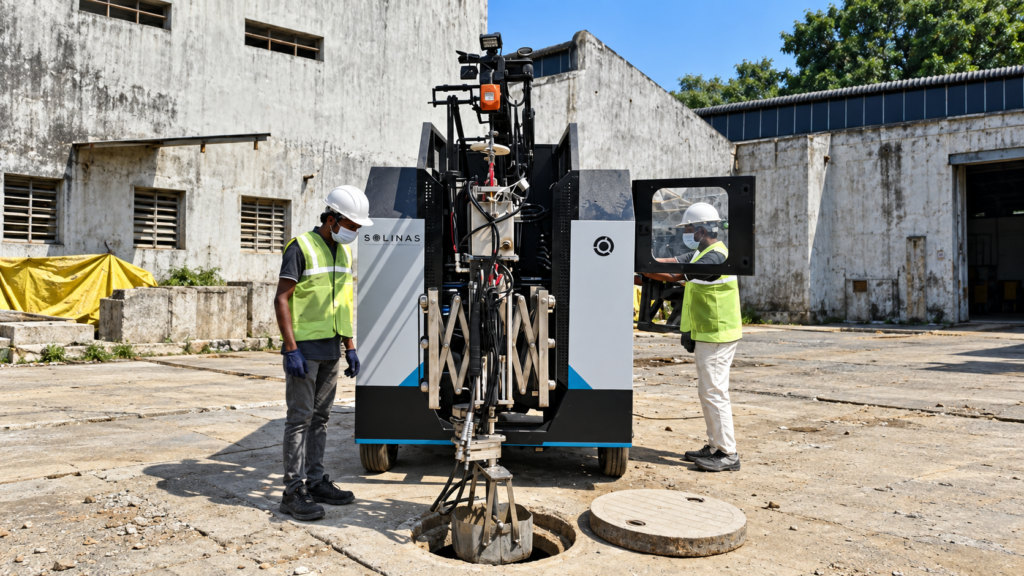
Robotic sewer cleaning for municipalities involves removing accumulated sludge, sediment and solid waste from a city’s sewer infrastructure to help maintain wastewater flow. In Noida, our team used Homosep Sewer to clean manholes from above ground, without requiring sanitation workers to enter them.
We spend time looking at what happens on the ground: what our teams encounter, how they respond and whether the equipment helps them complete the work safely.
Our project with the HCL Foundation and the Noida Authority has given me many reasons to reflect on that responsibility. One particular site visit stays with me.
How did Solinas support the project?
The CSR initiative brought together HCL Foundation and Noida Authority to deploy robotic manhole cleaning with Homosep Sewer and train local sanitation workers.
Our support includes:
- A Homosep robotic cleaning system.
- A Solinas operator.
- Operations and maintenance assistance for two years.
- Training for sanitation workers based in Noida.
We believe this operational support matters as much as the initial deployment. Teams need practical training and continued assistance to use the equipment confidently across different sites.
Why Traditional Manhole Cleaning Needs a Better Approach?
Over the years, one thing we have learned is that no two manholes are the same. Our experience in Noida reinforced this, as field teams encountered several challenges that conventional suction equipment alone could not address.
Real-World Challenges in Municipal Manhole Cleaning
- Hardened Sludge: Thick, compacted deposits were difficult to remove using conventional suction machines.
- Varying Manhole Structures: Deformed structures require adjustments to the cleaning approach.
- Restricted Access: Limited space made positioning and operating equipment challenging.
- Solid Waste and Debris: Accumulated waste obstructed suction equipment and complicated cleaning operations.
This is where adaptable robotic sewer cleaning technology like Homosep Sewer makes a difference, helping operators tackle challenging conditions while reducing the need for human entry.
How did our Homosep Sewer help us throughout?
Homosep Sewer is designed to address diverse challenges from hardened sludge and restricted access to varying manhole structures through mechanised manhole cleaning, allowing operators to control the cleaning process from above ground without requiring human entry.
Breaks Down Hardened Sludge with Homogenisation Technology
Homosep’s patented homogenisation technology breaks down hardened sludge and compacted deposits, making them easier to remove using suction equipment.
During our Noida project, this mechanism proved particularly effective in tackling stubborn sludge deposits that conventional suction machines struggled to remove.
Removing Solid Waste with a 17-Litre Grabber
The robot’s 17-litre grabber bucket collects solid waste, debris, and materials that conventional suction equipment may struggle to handle.
Its integration with suction and jetting equipment further supports effective sludge removal.
Safer Operations with Advanced Features
- Cameras and focus lights provide visibility inside the manhole. Gas detection sensors, a stabilisation system and remote controls support controlled operations. The operator remains responsible for assessing progress and adjusting the cleaning process to site conditions.
Combining Human Expertise with Robots
While Homosep handles the challenging cleaning tasks, trained operators remain in control, adapting the process to different site conditions.
This combination of human expertise and robotic technology makes Homosep a practical solution for underground sanitation maintenance.
To understand its capabilities and wider applications, explore why Homosep Sewer is a reliable sewer cleaning robot for Indian cities.
Six Takeaways from the Noida Project
Our experience in Noida showed us what can be achieved when cities, industry, and CSR partners work together.
- CSR collaborations can help bring new technologies, industry expertise, and resources to cities, allowing them to adopt better solutions faster and create opportunities for training, local capacity building, and safer ways of working that continue even after the project is completed.
- Technology should be tested under real-life conditions.
- Experience Matters as Much as Equipment
- Worker training is essential.
- Safety and efficiency have to go together.
- When people work together, they create long-lasting opportunities.
Thanks to the HCL Foundation CSR & The Noida Authority
We are grateful to HCL Foundation and the Noida Authority for their trust and collaboration. Our sincere thanks also go to the field teams and sanitation workers, whose dedication and hard work have made this progress possible.
What gives me particular pleasure is that growing cities such as Noida are adopting robotic technologies for the sake of the greater good.
We hope that these initiatives will encourage other developing cities to adopt innovation and to develop safer and smarter infrastructure, both above and below ground.
We’re pleased that our team has been able to take part in that journey.

Parthasarathy S
Parthasarathy, with over 5+ years of experience contributes to the execution and operational delivery of technology-driven solutions for water and sanitation infrastructure. With a background in procurement, contract management, and field operations, he brings a practical perspective to project execution and operational coordination.