
Insights From Solinas
By Arokiyaraj Benjamin,
Head – Marketing & Communications, Team Solinas
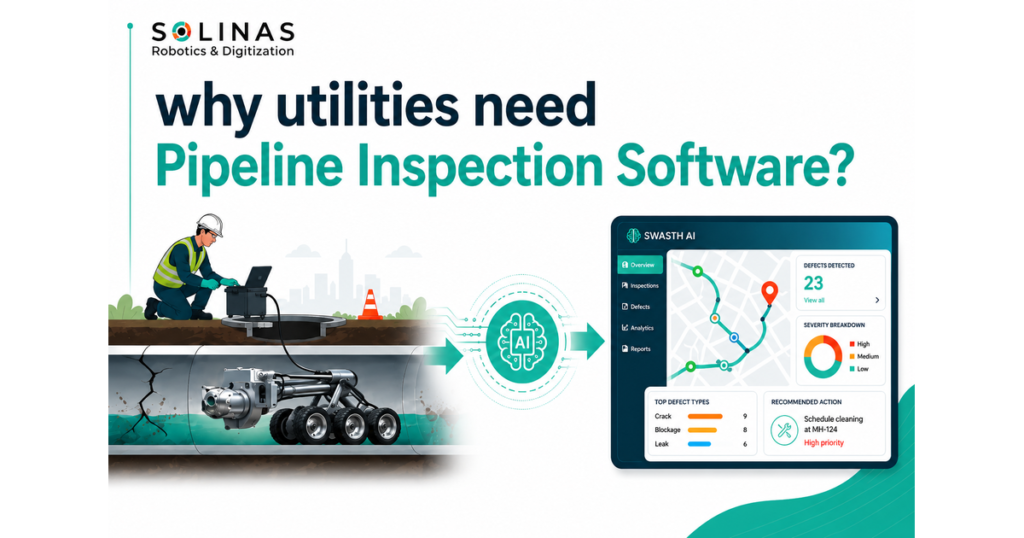
AI Pipeline Inspection Softwares bring defect detection, severity grading, GIS mapping and reporting all into one workflow. Reviewers can go in and check what the software has found and then pass the results on to the teams that are responsible for planning the maintenance.
A CCTV recording may show the roots actually entering the sewer via a joint. Prior to any decision being made as to what action is required, the inspector will need to confirm the defect and record the location of it.
The maintenance team can then go and look at the pipe history and work out how urgently it needs attending. AI pipeline inspection software like Swasth AI enables the utility to turn the inspection footage into the condition records that the decision-making process is based upon.
How does Swasth AI turn footage into a condition record?
1. Upload the footage against the correct pipe.
Start with a CCTV or robotic inspection video and the pipe ID, inspection date and direction of travel. That information enables the team to match the video to the right section of the network.
2. Flag, classify and grade any visible defects.
Swasth AI looks at the footage for any of the supported defects (cracks, displaced joints, root intrusion, etc.), classifies them and assigns a severity grade so the reviewer can see which ones may require further attention.
3. Verify findings prior to reporting.
The inspector checks each flag against the footage, corrects any classifications or grades and adds any observations that were missed. If there’s water, debris or poor lighting which means part of the pipe is not visible then the reviewer can record that visibility gap and make a decision as to whether a further inspection is required.
4. Map the findings and produce the report.
With the verified GIS data, the utility can link the findings to the correct pipe section. The report will contain the defect type, severity, the supporting image (where available) and the distance from the start of the inspection (where available). That enables the maintenance team to locate the affected section on the map and the observation in the video.
Read more about how CCTV inspection software cuts footage review time.
How utilities decide which pipe needs attention first?
Imagine two sewer sections both showing root intrusion of the same severity. One of them has a history of repeated overflows in the vicinity of a major road, the other has had no service issues at all. The same grade would lead to very different priorities.
The utility would likely put the first one in for review sooner, look at the footage to see where the roots are entering and then decide whether to clear the root or go and investigate the affected joint for repair.
The same principle applies to different networks. In a stormwater drain you can look at the footage and see where the sediment has actually narrowed the flow path prior to the wet season.
In a water main you can see the deposits or the damaged joint. You can bring in other information such as the pressure records if that’s the case
The future of Pipeline Inspection
Traditional sewer or water pipeline inspection methods helped cities manage sanitation systems for many years. But today, they are no longer sustainable on their own.
The future must move towards:
- AI-based defect detection
- GIS-based sewer asset mapping
- Preventive sewer maintenance
- Data-driven sanitation infrastructure management
To learn more about Solinas’ work in robotic pipeline inspection, AI-based infrastructure digitization and mechanised sanitation solutions, visit Solinas Integrity.